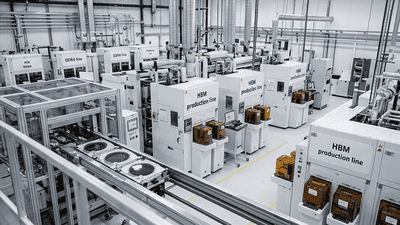
China’s drive to localize advanced memory technologies has accelerated over the past several years. High-Bandwidth Memory (HBM) sits near the center of that strategy because it is integral to AI accelerators, high-performance computing (HPC) and other strategic compute platforms. Two domestic players—ChangXin Memory Technologies (CXMT) and XMC (Xianghui Memory, commonly referred to as XMC)—have become focal points in assessing how quickly China can close the gap with international incumbents on HBM die, stacking, and packaging.

Why HBM localization matters
HBM is not just another DRAM product: it combines advanced wafer processing, 3D stacking, precision thinning, TSV or hybrid-bond interfaces, and advanced packaging (silicon interposers, CoWoS-style assemblies, or alternative 2.5D/3D approaches). Localizing HBM capability reduces strategic dependency on non-domestic suppliers for critical compute components and strengthens the domestic ecosystem across toolmakers, materials suppliers, and OSATs. For China, success in HBM localization supports sovereign capabilities in AI infrastructure, defense-related HPC, and industrial technology sovereignty.
Overview: CXMT and XMC roles

Both CXMT and XMC were founded with state and private support to expand China’s memory capability. Their strategic positioning differs:
- CXMT: Historically focused on DRAM process development and mass production capability for commodity DRAM segments, CXMT has been investing in higher-density DRAM die that serve as a stepping stone toward stacked memory products.
- XMC: Positioned to exploit flexible partnerships and targeted process flows, XMC emphasizes specialized products and niche process innovations intended to accelerate adoption of advanced stacked memory formats.
Both companies benefit from local political backing, domestic supply-chain incentives, and demand from Chinese cloud providers and AI firms. But moving from DRAM to HBM involves distinct technical and supply-chain hurdles that require deliberate investment and ecosystem building.
Technical progress to date (through 2026)
By mid-2026, CXMT and XMC have reached measurable milestones—but they are at different points on the maturity curve. Important technical advancements include:
- Die node and density improvements: CXMT has demonstrated progression toward smaller process nodes suitable for higher-density DRAM die, improving per-die capacity—an essential input for viable HBM stacks.
- Die thinning and back-side processing: Both companies developed in-house thinning and back-grinding capabilities adequate for thin-die handling, a prerequisite for stacking and hybrid-bond processing.
- TSV and hybrid-bond experimentation: Laboratory-scale TSV formation and early hybrid-bond process flows exist, though full production-grade hybrid-bond throughput and yield remain limited compared with global leaders.
- Packaging partnerships: Domestic OSATs and interposer initiatives have completed pilot CoWoS-style assemblies and 2.5D package prototypes integrating multiple die and simple memory stacks. These pilots validated interface designs and basic thermal/mechanical behavior.
- Qualification efforts: Early qualification runs with local cloud providers and AI startups produced functional modules for on-premise testbeds, enabling performance benchmarking and iterative improvement cycles.
These advances indicate that CXMT and XMC have moved beyond lab prototypes and into low-volume pilot production for certain HBM-like modules. Yet production scale, yield, and advanced packaging sophistication are still catching up to international incumbents.
Remaining technical and industrial gaps

Despite progress, several gaps remain that limit rapid, large-scale parity with SK Hynix, Samsung, and Micron:
- Yield and defect density: Fine-pitch hybrid bonding and high-die-count stacking exhibit steep yield curves. Domestic players are improving but still face higher defect rates and lower effective finished-module output versus mature vendors.
- Interposer and large-area silicon quality: Producing large, low-defect interposers at scale remains challenging. Surface cleanliness, warpage control, and large-area wafer handling are areas where experience matters.
- Advanced packaging throughput: Hybrid bonding and high-precision placement equipment have long lead times and are less abundant domestically. OSAT throughput bottlenecks limit how quickly pilot volumes can scale to production volumes.
- Materials and specialty consumables: High-quality low-k dielectrics, thermally conductive electrically insulating films, and specialized activation chemistries are still frequently sourced abroad, even if produced under license domestically.
- Test and qualification infrastructure: Full-package electrical and thermal testing at the scale needed for hyperscaler-grade HBM remains less developed, increasing cycle times for qualification and yield learning loops.
These gaps are partly technical and partly industrial-capacity related. Bridging them requires investments across tooling, materials, process IP, and human capital.
Supply-chain and ecosystem developments supporting catch-up
Several ecosystem moves accelerate localization capability:
- Domestic OSAT expansion: Chinese OSATs have prioritized hybrid-bond and fine-pitch assembly lines, often supported by local government incentives and preferential procurement from domestic customers.
- Interposer fabs and substrate development: New initiatives to build silicon interposer capacity and advanced substrate fabs target lower defectivity and improved yields for large-area interposers.
- Materials domestication: Chinese chemical and materials companies are scaling production of underfills, adhesives, and specialty dielectrics to substitute previously imported consumables.
- Tool acquisition and reverse engineering: Domestic firms have accelerated procurement of hybrid-bond tooling where possible; in parallel, local toolmakers work on incumbent-like capabilities, though some advanced lithography and metrology tools remain restricted by export controls.
- Customer pull and anchor procurements: Large domestic cloud providers, telecoms, and defense-related entities have placed pre-commitments or preferential procurement that give CXMT and XMC runway to prioritize capacity for local demand.
Public-private partnerships and targeted subsidies are smoothing some otherwise prohibitive near-term capex barriers, enabling quicker scale-up than purely market-driven investment might allow.
Geopolitical and regulatory constraints

China’s HBM localization effort must contend with export controls, technology restrictions, and global supply-chain fragmentation:
- Equipment and IP restrictions: Certain advanced processing and metrology tools and some packaging equipment are subject to export controls from countries including the United States and its partners, limiting access to state-of-the-art tooling.
- Licensing and software limits: Some EDA tools, process IP, and intellectual property remain difficult to license at parity with global leaders, necessitating local workarounds or slower reverse-engineering efforts.
- Dual-use considerations: HBM is relevant for both commercial AI infrastructure and strategic defense applications, increasing scrutiny on where and how technologies can be transferred or exported.
These constraints slow parity but also create incentives for China to accelerate domestic capability, amplifying investments into toolmaking, materials, and process research. Over time, this can reduce dependence—but near-term limits remain real and measurable.
Commercial strategies of CXMT and XMC
Both companies have pursued pragmatic commercial approaches tailored to their maturity level and market access:
- Focused domestic anchor customers: Selling early HBM-like modules to domestic hyperscalers, national labs, and telecom infrastructure providers creates secure revenue and real-world test cases.
- Tiered product approach: Rather than immediately targeting the highest-performance HBM3e/HBM4 segments globally, both firms produce incremental, high-density stacked DRAM and lower-stack-count HBM derivatives suitable for many domestic accelerator designs.
- Partnerships with local OSATs and toolmakers: These reduce reliance on foreign partners and accelerate integration between die production and packaging.
- Co-investment and procurement deals: Some cloud providers prepay or commit to volumes in exchange for prioritized allocations and iterative co-development, shortening the feedback loop for yield and performance tuning.
These strategies emphasize pragmatic progress: secure reliable domestic customers first, develop repeatable manufacturing at small scale, then expand into more demanding product tiers as yields and packaging capacity improve.
Performance and product roadmap outlook
Through 2026, CXMT and XMC roadmaps indicate a staged migration toward full HBM parity:
- Near-term (2026–2027): Low- to mid-stack HBM derivatives and high-density commodity dies that serve domestic accelerator designs and HPC clusters. Focus on reliability, qualification, and modest volume production.
- Medium-term (2027–2029): Increase die capacity, improve hybrid-bond process windows, and scale interposer production to support higher-stack-count products and regional exports where permitted.
- Long-term (2030+): Achieve broader parity in yields and packaging sophistication, enabling competitive offerings in global high-performance segments—contingent on tooling access, supply-chain maturation, and IP development.
Timeline convergence will depend on the rate of tooling acquisition, the efficacy of reverse-engineered process IP, and the strength of coordinated public-private investment programs.
Economic and market implications
Successful localization by CXMT and XMC has several market effects:
- China’s domestic procurement costs may fall: As local supply increases, prices for HBM-like modules in the domestic market should become more competitive, benefiting cloud providers and AI firms operating in-country.
- Global supply dynamics: Regionalization of supply could lead to bifurcated markets—domestic Chinese HBM supply and global HBM supply—each with different price and qualification dynamics.
- Downstream ecosystem growth: Domestic OSATs, interposer fabs, and materials suppliers will grow, creating jobs and industrial capability but also raising the global competition for high-end packaging services.
- Export potential and restrictions: If CXMT and XMC achieve higher performance and reliability, they may seek export markets for lower-tier HBM products; however, geopolitical constraints could limit high-end export opportunities for some time.
Strategic recommendations for stakeholders
Given the current trajectory, different stakeholders should consider the following actions:
- For global OEMs and hyperscalers: Maintain diversified supply chains and continue multi-sourcing strategies. Where procurement in China is necessary, qualify domestic modules early but keep global suppliers for top-tier, performance-critical deployments.
- For investors: Track tooling purchases, OSAT partnerships, yield announcements, and major pre-commitment contracts. Early signs of sustained yield improvement and packaging throughput expansion are key value inflection points.
- For policymakers and local industry planners: Continue support for tooling, materials, and interposer fabs, but prioritize workforce development, IP generation, and validation testbeds to accelerate reliable scale-up.
- For CXMT and XMC: Focus on yield engineering, vertical coordination with OSATs, and securing anchor customers that fund ramp. Avoid overextending into ultra-high-end segments before fundamental yield parity is achieved.
Risks and caveats
Several caveats temper optimism about rapid catch-up:
- Time-to-parity uncertainty: Experience and subtle process know-how matter a great deal; despite strong investment, narrowing the gap can take multiple technology cycles.
- Export-control volatility: Shifts in international policy can abruptly change access to tools and materials, slowing progress or forcing costly local substitutes.
- Quality and reliability expectations: High-end global customers impose demanding qualification regimens; meeting these standards at scale remains a long-tail challenge.
- Capital intensity: Building the required packaging, interposer, and metrology capacity is expensive and requires sustained demand to amortize investment.
These factors mean that while domestic HBM capability will grow, full parity across all product tiers and scales will be gradual rather than instantaneous.
What to watch next (near-term signals)
To gauge how fast CXMT and XMC are closing the gap, monitor the following indicators:
- Yield curves and production throughput reported in investor updates or inferred from shipment volumes.
- Public announcements of OSAT and interposer capacity expansions with clear hybrid-bond or TSV capabilities.
- Major domestic cloud providers’ procurement disclosures, benchmarking studies, or pilot deployment reports using locally sourced modules.
- Materials and tooling procurement by domestic firms—large purchases or domestic tool launches signal acceleration.
- Qualification milestones achieved with credible third-party audits or cross-validation against international performance baselines.
Conclusion
By 2026 CXMT and XMC have made meaningful strides in localizing HBM-related capabilities—moving beyond conceptual roadmaps to pilot production, packaging experimentation, and early customer deployments. They benefit from a policy environment and domestic demand that provide runway for investment. However, important gaps in yield, interposer quality, packaging throughput, and access to some advanced tooling remain. Closing those gaps requires sustained investment, skilled workforce development, and ecosystem coordination across materials, toolmakers, and OSATs.
For stakeholders—domestic customers, global OEMs, investors, and policymakers—the sensible posture is one of cautious engagement: recognize and leverage improvements in domestic capacity where suitable, retain global multi-sourcing for top-end performance, and watch key technical signals closely. Over the coming 3–5 years, China’s HBM localization will likely move from pilot-scale proof points toward more substantive production capability, but full parity with the most advanced global suppliers will remain contingent on addressing the remaining technical, industrial, and geopolitical constraints.